

 Image 1 of 1
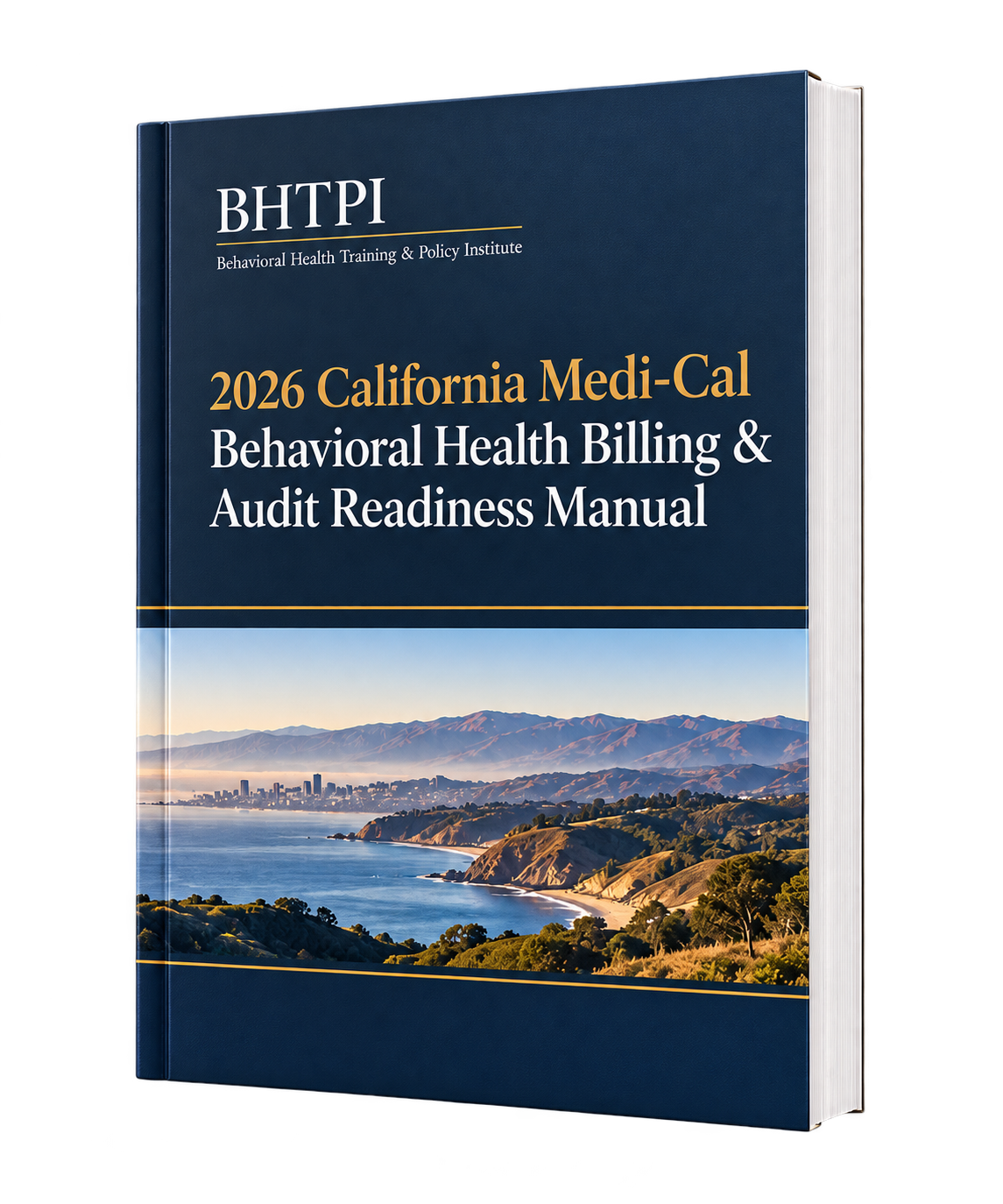
2026 California Medi-Cal Behavioral Health Billing & Audit Readiness Manual
A beginner-friendly, step-by-step guide to understanding services, documentation, claims, reimbursement, and audit readiness
The 2026 California Medi-Cal Behavioral Health Billing & Audit Readiness Manual is a comprehensive digital resource designed to help behavioral health organizations understand what Medi-Cal billing requires, where billing activities occur, who is responsible, and how services move from delivery to reimbursement.
Developed by the Behavioral Health Training & Policy Institute (BHTPI), this 657-page manual translates complex California Medi-Cal requirements into clear operational guidance for professionals who may be new to Medi-Cal, behavioral health billing, or organizational compliance.
Rather than presenting billing as an isolated finance function, the manual connects eligibility, provider enrollment, service delivery, clinical documentation, diagnosis, coding, claims submission, payment reconciliation, denial management, quality assurance, and audit readiness.
Every section answers the essential questions
Each substantive section includes detailed guidance organized around:
Who: The staff, practitioners, supervisors, reviewers, vendors, and external entities involved
What: A plain-language explanation of the requirement, process, or billing term
Where: The EHR, clearinghouse, county system, managed care portal, payer platform, documentation record, or internal work queue where the activity occurs
When: The required timing, frequency, deadline, or triggering event
Why: The connection to compliance, reimbursement, service integrity, and audit exposure
How: Step-by-step instructions for completing, reviewing, documenting, and verifying the activity
What the manual covers
The manual provides practical guidance on:
California Medi-Cal behavioral health delivery systems
Medi-Cal fee-for-service and managed care
County Mental Health Plans and Specialty Mental Health Services
Drug Medi-Cal and DMC-ODS billing
ECM and Community Supports billing pathways
Provider enrollment, credentialing, contracting, and taxonomy
Member eligibility and payer responsibility
Referrals, authorizations, and service planning
Behavioral health service delivery
Medical necessity and supporting documentation
ICD-10-CM behavioral health diagnoses
CPT and HCPCS behavioral health codes
Modifiers, place of service, time, and units
CMS-1500, 837P, UB-04, and 837I claim concepts
Short-Doyle/Medi-Cal and county-contracted-provider workflows
EHR and practice-management systems
California-capable clearinghouse considerations
Electronic acknowledgments, including 999 and 277CA transactions
Electronic remittance advice and 835 processing
Reimbursement and rate validation
Claim creation and pre-bill review
Rejections, denials, corrected claims, voids, and appeals
Accounts receivable and underpayment management
Billing quality assurance
Record-to-claim auditing
Corrective and preventive action
Recoupments and repayment exposure
Audit-response management
Privacy, security, and business continuity
Technical assistance and continuous improvement
Practical instruction for new billers
The manual explains where to begin before entering a code or creating a claim. Readers learn how to:
Identify the member and responsible payer.
Verify eligibility for the date of service.
Confirm provider enrollment, credentials, taxonomy, and contract status.
Determine whether the service is covered and authorized.
Review the documentation supporting the service.
Select and validate claim information.
Submit the claim through the correct pathway.
Confirm claim-level acceptance.
Reconcile payment and remittance information.
Correct errors and retain audit evidence.
Built for implementation—not just reading
The manual includes:
52 structured chapters
Detailed teaching and narration scripts
Plain-language terminology
California behavioral health examples
Guided claim-processing procedures
Operational workflows
Risk and control reviews
Technical-assistance questions
Evidence-retention guidance
Audit-readiness checkpoints
Practice scenarios and rationales
Source-control guidance
Reference-maintenance tools
Behavioral health billing glossary
Recommended for
Community-based organizations entering Medi-Cal
Behavioral health provider organizations
County-contracted providers
Mental health and substance-use programs
Medi-Cal managed care network providers
Billing and revenue-cycle staff
Clinical and program teams
Quality assurance and compliance professionals
Finance and administrative personnel
Executives and organizational leaders
Consultants and technical-assistance providers
EHR implementation and data teams
Digital product format
This product is delivered as a downloadable PDF for convenient electronic access and internal organizational use. It can be used for:
Staff onboarding
Billing-team training
Leadership education
Workflow development
Policy and procedure review
Internal quality assurance
Technical-assistance engagements
Pre-bill claim review
Corrective-action planning
Audit preparation
Important notice
This manual is an educational and operational resource. It does not constitute legal advice, coding advice for a specific claim, payer approval, or a guarantee of reimbursement. Medi-Cal requirements may vary by delivery system, county, managed care plan, program, provider type, contract, service, and date of service.
Users must confirm current requirements through applicable DHCS guidance, county and managed care plan manuals, contracts, companion guides, service tables, fee schedules, and licensed code sets before submitting claims.
The 2026 source framework was reviewed through August 1, 2026. Licensing and permitted organizational use depend on the license selected at purchase.
Digital download. No physical book will be shipped.
A beginner-friendly, step-by-step guide to understanding services, documentation, claims, reimbursement, and audit readiness
The 2026 California Medi-Cal Behavioral Health Billing & Audit Readiness Manual is a comprehensive digital resource designed to help behavioral health organizations understand what Medi-Cal billing requires, where billing activities occur, who is responsible, and how services move from delivery to reimbursement.
Developed by the Behavioral Health Training & Policy Institute (BHTPI), this 657-page manual translates complex California Medi-Cal requirements into clear operational guidance for professionals who may be new to Medi-Cal, behavioral health billing, or organizational compliance.
Rather than presenting billing as an isolated finance function, the manual connects eligibility, provider enrollment, service delivery, clinical documentation, diagnosis, coding, claims submission, payment reconciliation, denial management, quality assurance, and audit readiness.
Every section answers the essential questions
Each substantive section includes detailed guidance organized around:
Who: The staff, practitioners, supervisors, reviewers, vendors, and external entities involved
What: A plain-language explanation of the requirement, process, or billing term
Where: The EHR, clearinghouse, county system, managed care portal, payer platform, documentation record, or internal work queue where the activity occurs
When: The required timing, frequency, deadline, or triggering event
Why: The connection to compliance, reimbursement, service integrity, and audit exposure
How: Step-by-step instructions for completing, reviewing, documenting, and verifying the activity
What the manual covers
The manual provides practical guidance on:
California Medi-Cal behavioral health delivery systems
Medi-Cal fee-for-service and managed care
County Mental Health Plans and Specialty Mental Health Services
Drug Medi-Cal and DMC-ODS billing
ECM and Community Supports billing pathways
Provider enrollment, credentialing, contracting, and taxonomy
Member eligibility and payer responsibility
Referrals, authorizations, and service planning
Behavioral health service delivery
Medical necessity and supporting documentation
ICD-10-CM behavioral health diagnoses
CPT and HCPCS behavioral health codes
Modifiers, place of service, time, and units
CMS-1500, 837P, UB-04, and 837I claim concepts
Short-Doyle/Medi-Cal and county-contracted-provider workflows
EHR and practice-management systems
California-capable clearinghouse considerations
Electronic acknowledgments, including 999 and 277CA transactions
Electronic remittance advice and 835 processing
Reimbursement and rate validation
Claim creation and pre-bill review
Rejections, denials, corrected claims, voids, and appeals
Accounts receivable and underpayment management
Billing quality assurance
Record-to-claim auditing
Corrective and preventive action
Recoupments and repayment exposure
Audit-response management
Privacy, security, and business continuity
Technical assistance and continuous improvement
Practical instruction for new billers
The manual explains where to begin before entering a code or creating a claim. Readers learn how to:
Identify the member and responsible payer.
Verify eligibility for the date of service.
Confirm provider enrollment, credentials, taxonomy, and contract status.
Determine whether the service is covered and authorized.
Review the documentation supporting the service.
Select and validate claim information.
Submit the claim through the correct pathway.
Confirm claim-level acceptance.
Reconcile payment and remittance information.
Correct errors and retain audit evidence.
Built for implementation—not just reading
The manual includes:
52 structured chapters
Detailed teaching and narration scripts
Plain-language terminology
California behavioral health examples
Guided claim-processing procedures
Operational workflows
Risk and control reviews
Technical-assistance questions
Evidence-retention guidance
Audit-readiness checkpoints
Practice scenarios and rationales
Source-control guidance
Reference-maintenance tools
Behavioral health billing glossary
Recommended for
Community-based organizations entering Medi-Cal
Behavioral health provider organizations
County-contracted providers
Mental health and substance-use programs
Medi-Cal managed care network providers
Billing and revenue-cycle staff
Clinical and program teams
Quality assurance and compliance professionals
Finance and administrative personnel
Executives and organizational leaders
Consultants and technical-assistance providers
EHR implementation and data teams
Digital product format
This product is delivered as a downloadable PDF for convenient electronic access and internal organizational use. It can be used for:
Staff onboarding
Billing-team training
Leadership education
Workflow development
Policy and procedure review
Internal quality assurance
Technical-assistance engagements
Pre-bill claim review
Corrective-action planning
Audit preparation
Important notice
This manual is an educational and operational resource. It does not constitute legal advice, coding advice for a specific claim, payer approval, or a guarantee of reimbursement. Medi-Cal requirements may vary by delivery system, county, managed care plan, program, provider type, contract, service, and date of service.
Users must confirm current requirements through applicable DHCS guidance, county and managed care plan manuals, contracts, companion guides, service tables, fee schedules, and licensed code sets before submitting claims.
The 2026 source framework was reviewed through August 1, 2026. Licensing and permitted organizational use depend on the license selected at purchase.
Digital download. No physical book will be shipped.